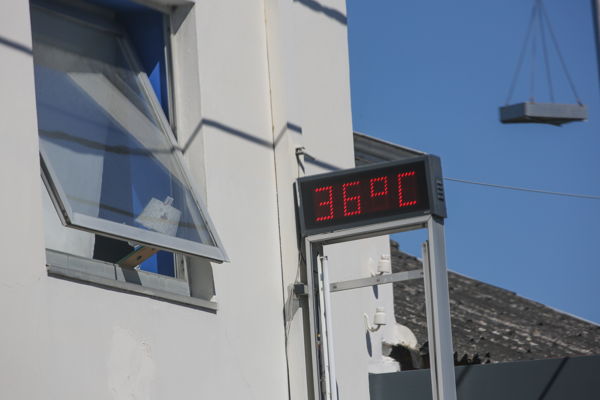
Long heat waves five times more frequent than in the 1980s, Flemish study finds

The probability of a heat wave lasting at least 12 consecutive days, such as the one that ended Monday, has increased fivefold since the 1980s. Such a heat wave now strikes once every seven years on average, according to calculations by climate scientists at Flemish Institute for Technological Research (VITO).
Belgium's Royal Meteorological Institute (RMI) defines a heat wave as at least five consecutive days with a maximum temperature of 25 degrees or more, including at least three days above 30 degrees. Since 1975, the RMI has recorded only seven heat waves of at least 12 consecutive days at its weather station in Uccle.
VITO's climate scientists calculated how the annual probability of such a long heat wave has evolved over time. In the 1980s, that probability stood at around 3 per cent, or once every 30 years. That probability has risen fivefold to an average of once every seven years, according to the institute.
Long heat waves are set to become even more common beyond 2030, according to the institute. The most optimistic scenario foresees the probability stabilising at once every four years after 2060, while the most pessimistic scenario points to heat waves striking in two out of every three years.


Adapt on two fronts
"If we want to reduce the risks of increasingly frequent heat waves, we need to act on two fronts," said Hendrik Wouters of VITO. "We must further cut greenhouse gas emissions by continuing the transition to renewable energy, phasing out fossil fuels and making industry more sustainable."
"But we must also adapt to the warming that is already unavoidable," Wouters added. For example, most buildings are still constructed without taking summer heat into account. Smart insulation, sun blinds and passive cooling can lower indoor temperatures without increasing electricity use.
"The heat wave we have just experienced makes clear once again that climate adaptation is not a problem for the future, but a task for today"
"The heat wave we have just experienced makes clear once again that climate adaptation is not a problem for the future, but a task for today," Wouters said. In Flemish cities, VITO is developing heat stress maps that show exactly where heat hits hardest, which allows them to propose targeted measures for individual districts and streets.
VITO's scientists based their calculations on CMIP6 climate models, the most recent generation of climate projections produced by scientists worldwide, combined with a long-term analysis of daily maximum temperatures.
#FlandersNewsService | PHOTO © Wojtek RADWANSKI / AFP
Related news